

How Does an Automatic Self-Priming Peripheral Pump Maintain Prime Without Manual Intervention
2026-04-29
For residential water supply, irrigation, and industrial transfer systems, losing prime is a common frustration. A standard pump requires manual refilling of the casing before each start. However, the Automatic Self-Priming Peripheral Pump – such as those engineered by SINYOA – eliminates this chore entirely through intelligent hydraulic design.
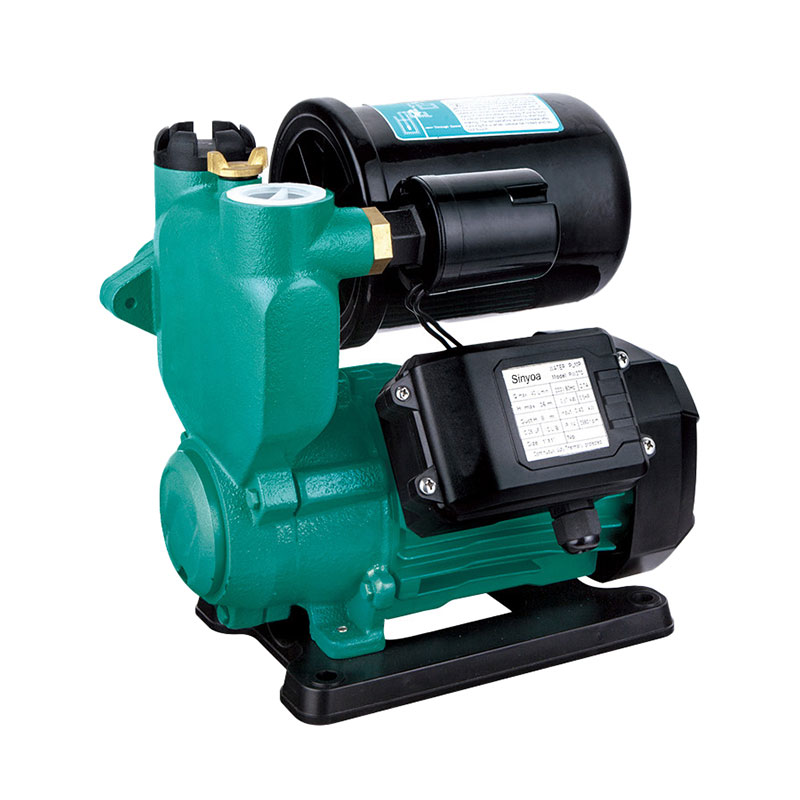
The Mechanism Behind Automatic Prime Retention
An Automatic Self-Priming Peripheral Pump maintains prime by combining a recirculation chamber with a built-in check valve system. When the pump starts, the impeller rotates at high speed, creating centrifugal force. Residual liquid inside the casing is flung outward, generating a partial vacuum at the suction inlet. This vacuum draws air from the suction line into the pump casing, where it mixes with the recirculating liquid inside a specially designed priming chamber.
The key differentiator is the air‑liquid separation process. Within the pump, air rises into a separate volute zone while the heavier liquid falls back toward the impeller for another cycle. Over 10–30 seconds (depending on suction lift height and pipe length), all entrained air is expelled through the discharge port, and the pump transitions to full liquid flow – all without any operator refilling the casing.
Structural Advantages Over Conventional Pumps
| Feature | Automatic Self-Priming Peripheral Pump | Standard Peripheral Pump |
|---|---|---|
| Prime retention after shutdown | Automatic via check valve and recirculation port | None – requires manual refill |
| Check valve integration | Factory-fitted, spring-loaded silent valve | Often external or absent |
| Air handling capacity | Up to 4 meters of suction lift with air mixed | Zero air tolerance |
| Restart behavior | Instant prime without intervention | Dry running risk if not refilled |
Automatic Self-Priming Peripheral Pump FAQ – Common Questions
Q: How long does it take for an Automatic Self-Priming Peripheral Pump to re‑prime after the suction line has been completely drained for maintenance?
A: When the suction line is fully drained (e.g., after filter cleaning or pipe repair), the pump typically re‑primes within 30 to 90 seconds. The exact time depends on three factors: the vertical suction lift height (measured from water level to pump inlet), the diameter of the suction pipe, and the total number of elbows or valves in the line. For a typical residential setup with a 2‑meter lift and 1‑inch pipe, SINYOA models achieve full prime in under 45 seconds. The pump can safely run dry during this short re‑priming phase because the peripheral impeller and casing are manufactured from wear‑resistant materials with self‑lubricating properties.
Q: Can an Automatic Self-Priming Peripheral Pump lose its prime permanently if the discharge valve is left closed for weeks?
A: No, permanent prime loss will not occur solely from keeping the discharge valve closed. The pump contains a non‑return check valve at the suction inlet which prevents water from draining back to the source when the pump is off. However, if the discharge valve remains closed while the pump runs continuously, the internal temperature may rise due to recirculating liquid absorbing heat from the impeller. This can degrade the mechanical seal over time but will not erase the priming water inside the casing. SINYOA recommends either installing a bypass recirculation line or using a pressure switch to cycle the pump off when the discharge is closed for extended periods.
Q: What prevents an Automatic Self-Priming Peripheral Pump from losing prime through tiny air leaks on the suction pipe joints?
A: The pump’s automatic priming ability actively compensates for minor air ingress up to approximately 0.5 liters per minute at atmospheric pressure. Small air leaks (e.g., from a slightly loose union or a pinhole in a rubber gasket) allow air bubbles to enter the suction line while the pump is running. In a standard pump, this air accumulates and eventually breaks the liquid column, causing complete loss of prime. In an Automatic Self-Priming Peripheral Pump, the internal recirculation chamber continuously separates these incoming air bubbles and expels them through the discharge port without interrupting flow. Nevertheless, SINYOA advises fixing any leak larger than a slow drip, because excessive air entry reduces flow rate and increases energy consumption even if prime is maintained.
Why SINYOA Leads in Automatic Self-Priming Peripheral Pump Engineering
SINYOA integrates a double‑lip mechanical seal and a reinforced composite impeller specifically shaped to accelerate air‑liquid separation. Every pump undergoes a factory prime‑retention test where the suction line is evacuated to simulate a 5‑meter lift. Only units that re‑prime automatically within 60 seconds pass quality control.
Contact Us
To select the right Automatic Self-Priming Peripheral Pump for your project or to request a custom hydraulic performance curve, contact SINYOA directly through the website inquiry form or call the technical support team for a same‑day consultation.