

What Are the Common Failure Points in a 20L/5gal Pneumatic Grease Pump and How to Fix Them
2026-08-04
For maintenance teams and workshop operators, a 20L/5gal Pneumatic Grease Pump is the backbone of efficient fleet lubrication. When it runs well, productivity stays high. When it fails, downtime escalates fast. At WYMA, we have diagnosed thousands of pneumatic grease pump issues across mining, construction, and automotive facilities. The reality is that most failures follow predictable patterns. Understanding these weak points transforms costly breakdowns into five-minute fixes.
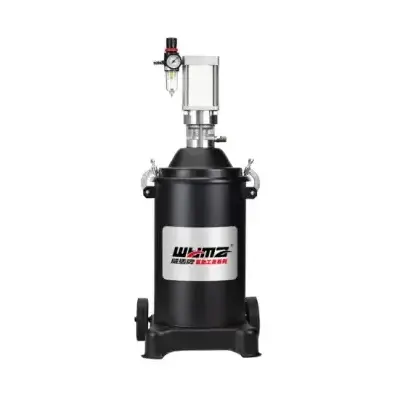
The 5 Most Common Failure Points
| Failure Point | Primary Symptom | Root Cause | Estimated Downtime |
|---|---|---|---|
| Air Motor Stalling | Pump stops mid-cycle, hissing sound | Moisture/dirt in air lines, worn O-rings | 15–30 min |
| Check Valve Leakage | Grease backflows, slow pressure build | Debris trapped under ball seat | 10–20 min |
| Packing Seal Wear | Grease leaks from pump head | Dry running or abrasive contaminants | 20–40 min |
| Suction Tube Blockage | Pump runs but no grease output | Thickened grease or solidified residue | 25–45 min |
| Pressure Regulator Drift | Inconsistent flow rate | Diaphragm fatigue or clogged pilot port | 10–15 min |
Deep-Dive Fixes for Each Failure
1. Air Motor Stalling
This accounts for nearly 40% of service calls. Moisture from compressed air corrodes the motor’s spool valve, while dirt scores the cylinder wall.
Fix: Install a coalescing air filter + dryer ahead of your 20L/5gal Pneumatic Grease Pump. Disassemble the motor, clean all parts with mineral spirits, and lubricate with light turbine oil. Replace the spool O-rings every 500 operating hours—WYMA offers a pre-assembled seal kit that cuts rebuild time by half.
2. Check Valve Leakage
The ball-and-seat check valve is the heart of prime retention. Even a 0.2mm particle can hold the ball off its seat, allowing grease to drain back into the pail.
Fix: Remove the check valve housing, extract the ball, and inspect the seat with a magnifying glass. Polish minor nicks with 1000-grit sandpaper. For severe pitting, replace the valve assembly. Pro tip from WYMA: always run the pump at 30–40 PSI for the first 10 strokes after a new pail install—this self-flushes any shipping debris.
3. Packing Seal Wear
Packing seals (usually V-stacking or U-cup) are the most consumable part of any 20L/5gal Pneumatic Grease Pump. They fail prematurely when the pump is run dry—even for 30 seconds.
Fix: Never operate without grease in the pail. When replacing seals, coat each lip with WYMA lithium-compatible grease before assembly. Torque the follower nut to exactly 15–18 ft-lbs—over-tightening creates excessive friction and heats the seal, reducing its life by 70%.
4. Suction Tube Blockage
Grease grades NLGI #2 and above can form a "bridge" inside the tube, especially when ambient temperatures drop below 10°C.
Fix: Heat the pail with a drum heater (not an open flame) for 20 minutes. Remove the suction tube and scrape out hardened residue with a wooden dowel. For cold climates, WYMA recommends switching to a follower plate system that presses grease from the top down, eliminating air pockets that cause bridging.
5. Pressure Regulator Drift
Operators set the regulator to 120 PSI, but after an hour, the output drops to 85 PSI—this is diaphragm creep.
Fix: Rebuild the regulator with a new diaphragm and pilot spring. Calibrate it using an inline digital gauge rather than the built-in analog one. Adjust the set point while the pump is actually dispensing (dynamic pressure), not while static. WYMA regulators come with a stainless-steel diaphragm that resists memory effect, holding setting within ±3 PSI.
Maintenance Schedule Table (Preventive)
| Interval | Action | Responsible |
|---|---|---|
| Daily | Drain air filter bowl, check grease level above suction port | Operator |
| Weekly | Lubricate air motor with 5 drops of oil, inspect hoses for cracks | Technician |
| Monthly | Remove and clean check valve + suction strainer | Lead Mechanic |
| Quarterly | Replace packing seals, test regulator accuracy | Supervisor |
| Annually | Full rebuild (motor seals, O-rings, check valve spring) | WYMA Service Partner |
20L/5gal Pneumatic Grease Pump FAQ
Q: Why does my 20L/5gal Pneumatic Grease Pump lose prime every time I change the grease pail?
A: This is almost always air trapped between the suction tube and the new pail’s grease surface. To solve it, lower the pump slowly (1 inch per second) so the tube pushes grease upward rather than compressing air downward. Then open the bleed valve on the pump head and run the motor at 60 PSI for 15 seconds—you will see grease mixed with bubbles, then solid grease. Close the bleed valve and resume normal operation. If the problem repeats, check the suction tube O-ring (at the pump head interface)—a flattened O-ring allows air to be drawn in from the top, not just from the pail.
Q: Can I run a 20L/5gal Pneumatic Grease Pump with a small workshop compressor (3 HP, 20-gallon tank)?
A: Yes, but with two critical limits. The pump consumes 8–12 CFM at 90 PSI intermittent, not continuous. A 20-gallon tank delivers about 5 CFM continuously—so you can dispense for 30–40 seconds, then wait 60–90 seconds for recovery. The real issue is pressure drop: if your compressor’s cut-out is 125 PSI and cut-in is 95 PSI, set your pump regulator to 80 PSI max. This leaves a 15-PSI buffer so the pump never sees fluctuating supply. WYMA tests show that running below 70 PSI increases seal wear by 200% because the motor strokes slower, allowing grease to cool and thicken inside the cylinder. So keep it between 80–100 PSI and monitor your tank recovery time.
Q: How do I know if the problem is the pump or the grease itself (e.g., expired or contaminated grease)?
A: Perform the "squirt test": remove the pump’s discharge hose, place a clean container under the head, and run the pump for 10 strokes. If grease comes out smooth and uniform, the pump is fine—your issue is downstream (clogged coupler, bent hose, or worn nozzle). If grease comes out with hard lumps, water droplets, or separation (oil weeping), the grease is degraded. Expired grease often has a rancid odor and a gritty texture when rubbed between fingers. In that case, empty the pail, flush the pump with WYMA flushing fluid (or light hydraulic oil), and reload with fresh grease. Never mix different soap-based greases (lithium vs. calcium)—they can react and form rubbery deposits that mimic mechanical failure. Always document the grease batch number and production date on your maintenance log.
Final Word
The difference between a costly breakdown and a quick adjustment comes down to diagnosis—not guesswork. Most failures in a 20L/5gal Pneumatic Grease Pump are mechanical, not mystical. With the right spare kit, a clean air supply, and the structured approach above, you can achieve 98% uptime across your lubrication stations.
WYMA manufactures every pump with oversized check valves and double-lip seals specifically engineered for high-volume workshops. Our technical team has mapped every failure mode in this guide—and we back our pumps with a 2-year wear warranty that includes free diagnostic support.
Contact us today for a free failure-point audit of your current grease pump setup. Send your pump model and operating hours to our service desk, and we will return a customized preventive plan within 24 hours. WYMA — keeping your lines moving, one stroke at a time. Reach out via our website or call your regional distributor to schedule a live demo.