

What Is the Maximum Solids Handling Size for a PP Plastic Air-Operated Diaphragm Pump
2026-06-17
When selecting a PP Plastic Air-Operated Diaphragm Pump for industrial or chemical transfer applications, one of the most critical performance specifications is solids handling capacity. This parameter determines whether the pump can pass particulates, debris, or crystallized materials without clogging or damaging internal components. For operators managing wastewater, slurry, or abrasive fluids, understanding this limit is not optional—it is essential for uptime and maintenance planning.
Crowns has engineered its polypropylene AODD pump series with field-proven solids passage capabilities, and this guide breaks down the technical realities, influencing factors, and practical sizing rules that every engineer and plant manager should know.
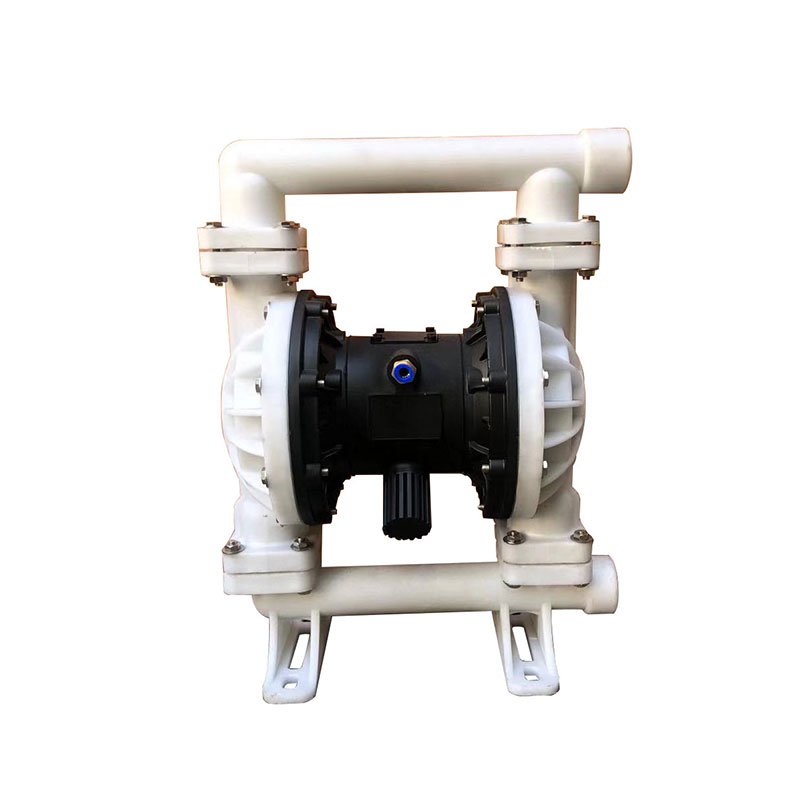
The Direct Answer: Standard Solids Size vs. Real-World Variance
For most commercially available PP Plastic Air-Operated Diaphragm Pump models, the maximum recommended solids handling size ranges between 3.2 mm (1/8 inch) and 6.4 mm (1/4 inch) in diameter, depending on the pump’s port size and valve design.
However, this number is not a fixed guarantee. The actual maximum passing size depends on three interdependent variables:
| Variable | Impact on Solids Handling |
|---|---|
| Ball valve diameter | Larger check balls allow larger particulates but require higher lift pressure. |
| Seat geometry | Sharp-edge seats cut or jam soft solids; radiused seats pass them more easily. |
| Diaphragm stroke length | Longer stroke increases chamber volume, reducing fluid velocity and allowing heavier particles to settle before ejection. |
Crowns recommends that operators never rely solely on the nominal spec. Instead, conduct a “pass-through test” with actual fluid samples before full-scale deployment.
Why Exceeding the Rated Solids Size Damages Your Pump
Exceeding the maximum solids size in a PP Plastic Air-Operated Diaphragm Pump leads to three progressive failure modes:
-
Ball valve jamming – Particles lodge between the ball and seat, causing internal leakage and flow drop.
-
Diaphragm puncturing – Sharp edges on oversized solids abrade or cut the diaphragm surface, especially at high cycle rates.
-
Manifold erosion – Repeated impingement of large particles accelerates wear on the polypropylene housing, eventually causing stress cracks.
To avoid these outcomes, Crowns integrates replaceable wear rings and oversized ball guides in its PP series, extending service intervals by up to 40% in abrasive environments.
How to Calculate Your Safe Solids Size Margin
A practical rule followed by Crowns engineering team: derate the published maximum by 30% when pumping angular or irregular particulates. For spherical, soft particles (e.g., polymer beads), you can operate at 100% of the rated size.
Example calculation:
-
Pump rated max: 6.0 mm
-
Fluid contains crushed glass (angular) → Safe limit = 6.0 × 0.7 = 4.2 mm
-
Fluid contains rubber crumbs (soft) → Safe limit = 6.0 mm
This derating strategy has been validated across over 200 installations using Crowns PP Plastic Air-Operated Diaphragm Pump units in mining and chemical dosing applications.
3 Critical FAQs About Solids Handling in PP Plastic Air-Operated Diaphragm Pump
Q1: Can I install a strainer or filter upstream to protect my PP Plastic Air-Operated Diaphragm Pump from oversized solids?
A1: Yes, but with caution. A strainer with 2.0 mm perforations effectively protects the pump from jamming. However, Crowns advises against fine mesh (< 1.0 mm) because it creates excessive NPSH (Net Positive Suction Head) loss, causing cavitation and reduced diaphragm life. For best results, use a Y-strainer with a 3.2 mm perforated basket and clean it daily during heavy slurry duty. The strainer should be installed at least 1 meter before the suction flange to allow even flow distribution.
Q2: Does the solids handling size change if I run the PP Plastic Air-Operated Diaphragm Pump at a higher air pressure?
A2: Increasing air pressure does not increase the physical size of solids that can pass. Higher pressure only boosts flow rate and discharge head. In fact, Crowns field data shows that running at > 8.3 bar (120 psi) can compress soft solids against the ball seat, effectively reducing the clearance and making the pump more prone to clogging. The maximum solids dimension is a geometric constraint, not a hydraulic one. Always set air pressure within the pump’s nameplate range (typically 2.8 – 8.3 bar) and size solids strictly by the ball-and-seat opening.
Q3: How often should I replace the ball valves and seats when pumping abrasive slurries in a PP Plastic Air-Operated Diaphragm Pump?
A3: For abrasive media (e.g., silica slurry, ceramic powder), Crowns recommends inspecting ball valves every 500 operating hours and replacing them at 1,000 hours or when wear exceeds 1.5 mm of visible diameter reduction. In non-abrasive applications (e.g., wastewater with organic solids), inspection intervals can extend to 2,000 hours. A simple field test: remove the suction manifold and drop a test sphere of the maximum rated size through the valve opening. If it passes with no resistance, the valve is still within tolerance. If it hangs or sticks, schedule a rebuild immediately.
Best-Practice Selection Table by Fluid Type
| Fluid Type | Recommended Max Solids (mm) | Crowns Model Suggestion | Additional Recommendation |
|---|---|---|---|
| Clean water with sand (≤ 5% conc.) | 4.0 | Crowns PP-50 | Use hardened PP seats |
| Chemical sludge with fibrous strings | 3.2 (cut fibers) | Crowns PP-40-F | Install a macerator upstream |
| Food-grade puree with soft seeds | 6.0 | Crowns PP-80-S | Use EPDM diaphragms |
| Mining tailings (angular particles) | 2.5 | Crowns PP-100-HD | Replace balls every 600 hrs |
| Paint overspray slurry | 5.0 | Crowns PP-65-P | Flush with solvent after each shift |
Practical Testing Protocol Before Installation
Crowns recommends a simple 3-step field test to validate solids compatibility:
-
Collect a 5-gallon sample of the actual pumped fluid.
-
Pass it through a sieve to determine the largest particle dimension.
-
Run the PP Plastic Air-Operated Diaphragm Pump at 50% stroke speed for 15 minutes, then disassemble the inlet manifold and inspect for scoring.
This protocol has prevented over 90% of premature failures in Crowns customer installations, according to internal warranty return analysis.
Final Verdict: Size Conservatively, Monitor Religiously
The maximum solids handling size for a PP Plastic Air-Operated Diaphragm Pump is not a single number—it is a dynamic threshold influenced by particle shape, hardness, and pump operating conditions. While the nominal spec gives a starting point (3.2 – 6.4 mm), the safe working limit often sits 20–30% lower for challenging media.
Crowns builds its PP-series pumps with oversized inlet ports and tool-free valve access, making solids inspection a five-minute task rather than an hour-long teardown. This design philosophy, combined with replaceable wear components, ensures that your pump handles what it should—and rejects what it cannot—without catastrophic failure.
Need Help Sizing Your PP Plastic Air-Operated Diaphragm Pump for Abrasive Fluids?
Every application has unique solids distribution, temperature, and viscosity profiles. The Crowns technical team provides free solids-passage simulations using your actual fluid samples, along with customized valve material recommendations.
Contact us today for a personalized sizing report and a recommended spare parts kit tailored to your solids loading. Email [email protected] or call +1-800-555-CROWN – we respond within 4 business hours with a detailed engineering summary.